Bryan Neubert Cowboy Clinician

Bryan Neubert was raised on a ranch in the Salinas California area. Bryan grew up around horses, cattle, and cowboys. His main goal in life was to be the best cowboy he could be. In his teens, Bryan became acquainted with Bill Dorrance who lived on a neighboring ranch. He worked with Bill for several years, starting colts and learning to braid rawhide. He later came to know Tom Dorrance and Ray Hunt and worked with them starting colts and riding horses. These early associations with the masters of horse psychology made a lasting impression on Bryan’s philosophy and his approach to handling all types of horses.
The Cowboy Years Bryan moved on in the cowboy world. He moved to the vast northern Nevada area where the ranches still ran wagon outfits. Bryan went to work on the huge Spanish ranch northwest of Elko, Nevada. This ranch is a “straight-up” buckaroo outfit adhering to the buckaroo traditions of handling horses, cattle and men. Part of Bryan’s job, while on this ranch, was starting horses. When he first started there, many of the horses were started as 8 year olds, which is a different philosophy than today’s practice of starting two year old colts. Many of these older horses were what are called “’big circle” horses that had some thoroughbred in the blood lines. It was believed that a horse couldn’t make the long miles until he was at least seven. In the old days on these ranches, they had used what was called the “bronco man” that started the horses for the cowboys. The horses were hobbled, blindfolded, saddled, mounted, and ridden to a standstill with very little ground work done before the horses were ridden. Bryan used the techniques he had learned from the Dorrances and Hunt to finesse the horses instead of trying to out muscle them. During this time, Bryan also started draft horse feed teams to pull hay wagons, as much of the livestock was fed with a team and wagon in the winter months. The word soon got out that Bryan had a way with horses. While Bryan was still single, he went back to Salinas, California during the winters and took in outside horses to train. After he left the Spanish Ranch, he married his wife Patty. They had three children, Jim, Kate, and Luke, all born in Elko. He took the job as cowboss for the Rafter Diamond Ranch near Deeth, Nevada. Here, he oversaw the running of 10,000 head of steers and a buckaroo crew. After his tours on the Nevada ranches, Bryan returned to California and was co-cowboss on a 30,000 head yearling cattle operation near Hollister. His job on this yearling outfit was tending and doctoring thousands of yearling pasture cattle. In order to do this, the cattle needed to be ridden on and, if they were sick, roped and doctored outside in the pastures. This was an excellent opportunity to ride and train young horses. He began to use cow dogs to assist him in handling the cattle and became an accomplished stock dog handler. He showed his stock dogs at the prestigious bull, gelding and stock dog sale at Red Bluff, California and had high selling dogs at the sale four out of five years. Bryan continued working on ranches and moved to the Alturas area. In 1992, he cracked out on his own, full-time, training horses. He bred and raised horses of his own and took in horses from outside customers. After a slow start, he soon began to find himself with more potential clients than he could facilitate. He enlisted the help of his wife, two sons and daughter who became accomplished horse people in their own rights. Clinician In the early 1990s, Bryan expanded his horse work into the clinic world. He has conducted clinics across the United States and Canada. Bryan is very low-key. His clinics are sold primarily by word of mouth. He quotes Tom Dorrance as saying “If you give people more than they ever thought they would get, you don’t need to advertise.” Bryan has also worked with the Department of Interior, Bureau of Land Management wild horse program. He started and trained wild mustangs that had been captured off the open range and were put in the horse adoption program. In the February, l996 edition of Western Horseman Magazine, Bryan was featured in a story entitled “Taking the Wild Out Of Mustangs.” Videos Bryan produced a video on the subject called “Wild Horse Handling.” He has also produced two videos on rawhide braiding-beginning and advanced. A new horse starting video, “The First Week,” filmed at the 6666 Ranch in Texas, with Bryan, his son Jim Neubert, and Joe Wolter will be available in the summer of 2004. These videos are available by contacting Bryan at his Alturas, California ranch or on his web site www.bryanneubert.com. 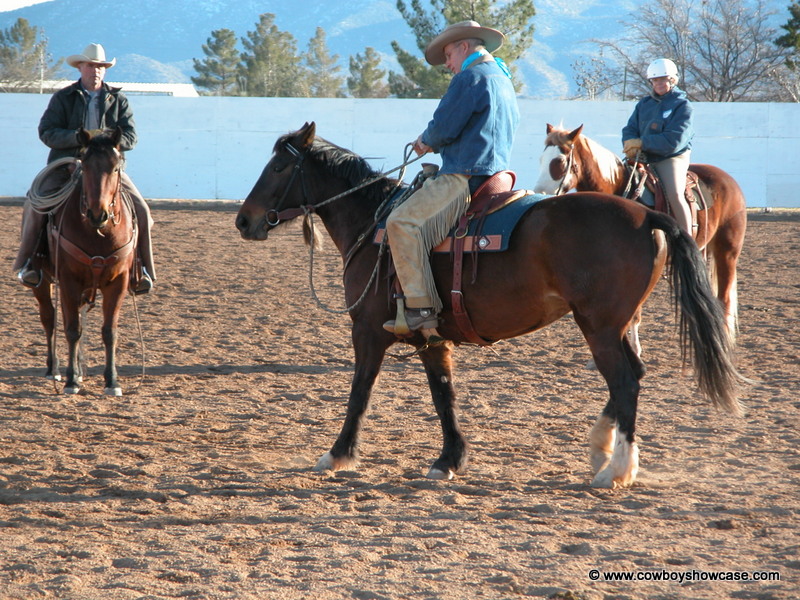
Colt Starting and Horsemanship Clinics
On February 6, 7, 8, 2004, we were invited to attend a three-day Bryan Neubert clinic on colt starting and horsemanship held at the J-Six Equestrian Center in Benson, Arizona. The clinic had seven colt starting and eight horsemanship participants and numerous spectators auditing the clinics. In the colt starting segment, Bryan presented a gentle introduction of steps to start your young horse under saddle or restart an older horse. He started each horse in a round pen on the ground holding on to the lead rope attached to the halter and using a flag attached to a handle around each horse. He moved the flag around the horse’s legs, body and head, getting above the horse’s back and head, desensitizing and reading the horse. The horses reacted with varying levels of fear and reaction, but soon became desensitized to the flag stimuli. He then had each horse led up against the fence inside of the round corral and had each participant rub the horse from above, while sitting on corral fence. Then the rider would work up to stepping off the corral onto their horses, bareback. Bryan encourages people to rub their horses, especially on the withers, mane, and poll and over the eye sockets. All during the clinics, Bryan maintained a running commentary and related stories concerning his cowboy days, about Bill and Tom Dorrance and Ray Hunt and other trainers, drawing from thousands of other experiences with similar problems so that people could better understand and relate. This commentary seemed to be soothing to both the horses and the participants. He didn’t put a lot of pressure on the participants or the horses. Progress was at their own pace. If the horse or the people did not understand, he would back up to a point where they could. He stressed this with both people and horses. The clinic participants then saddled their horses and “pulled them around” by throwing the halter lead rope over the saddle horn. This taught the colt to give to pressure from the lead rope around the saddle horn. After that, the horses, with their saddles left on, were turned out of the round pen into the arena to “soak.” (This term means getting used to a saddle on their backs.) Bryan checked to make sure there was a breast collar on each horse so that if they rolled the saddle would not end up under the horses’ belly. Bryan or another rider moved the saddled horses around the arena to get them used to the feel of moving under saddle before riders were added into the situation. Then the riders caught their horses then stepped up and put their weight in the on–side stirrup. They lay over the saddle, and patted the horse as far as they could reach on both sides. Those that felt comfortable stepped all the way up and got in the saddle. Each step built on the previous step and reinforced the next step. Soon all seven clinic participants were horseback, riding in the round pen. Bryan then said in his quiet way “Little things make a big difference. “ The afternoon horsemanship clinics emphasized increasing communication with your horse and transforming him or her into a willing partner. He worked on riders moving the horse’s hips and shoulders, preparing it for loping circles, turning around, changing leads, backing up, and cow work. The second day reinforced what was done the first day; plus, on the second day Bryan introduced the horses to cow work. He demonstrated how you can “hook up” a horse to follow a cow in a very short time. He placed a single horse and rider with a cow in the round pen and had the horse track the cow. This also gets a horse acquainted with cattle if your horse has not been around them before. Throughout this three day clinic Bryan was concerned for the safety of the people and their horses, encouraging them to proceed with the next step of training only when they felt confident to do so. This man is passionate about helping people with their horses and problems. Folks we talked to during this clinic said Bryan was a great communicator. They were able to understand an exceptional amount of information, presented on a personal level. There is no “smoke and mirrors” with Bryan Neubert; he is a true Horse Hand! Contact information: Bryan Neubert P.O. Box 726 Alturas, California 96101 530-233-3582 bneubert@hdo.net www.bryanneubert.com |
|

