The Cowboy Training Halter
Teaching Horses to Lead Using a Reata
|
Twister Heller, horse trainer from Congress, Arizona believes the easiest and most humane way to teach a horse to lead is by using a braided rawhide reata to make a cowboy training halter and using the technique he outlines below. This method can be used on horses that have never been handled, baby colts, mules, spoiled horses--any animal that you want to teach to lead or to lead better. Twister recommends that the cowboy training halter be used on an animal that is familiar with a regular halter. So, for a horse that does not yet know how to lead, the first day Twister will use a normal halter and a butt rope. (A butt rope is a long lead rope run around the horse's rear and run back through the halter.) He will work with the horse with this set-up for about 15 minutes a day for two days. Then he will work with the reata halter for about 15 minutes a day the next couple of days. By the end of the fourth day a horse should follow you anywhere you choose to go.
Twister likes to use a rawhide reata for his cowboy halters because he says that a reata "renders" (loosens) more easily than other types of lariat rope. A new and springy reata will render and loosen up by itself and give a horse slack when the horse comes forward. You may use another type of rope, but be sure that the rope is stiff and will loosen easily to offer a horse immediate relief from pressure when the horse cooperates. To put the cowboy halter on the horse:
First, choose an uncluttered area with plenty of room to work. (click on photos to see enlarged views) 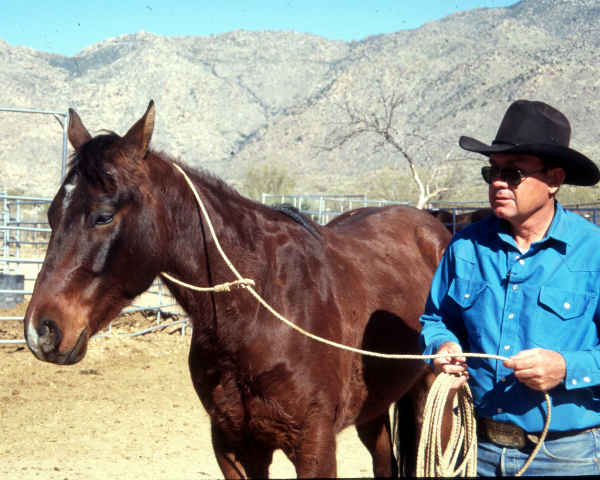
1. Put a loop of the reata around the horse's neck.
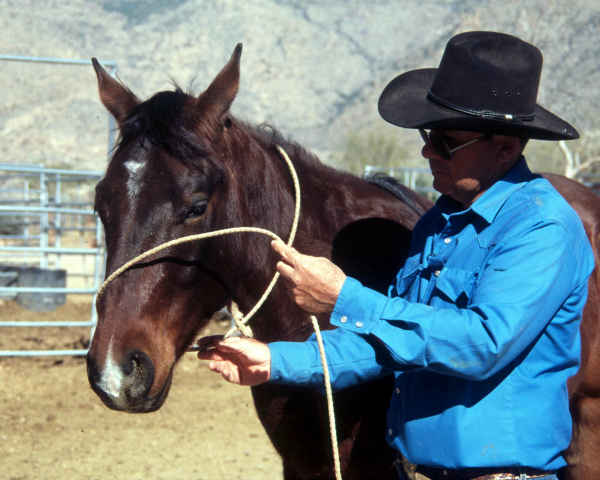
2. Then take a coil of reata and drop it under the jaw and then up over the nose.
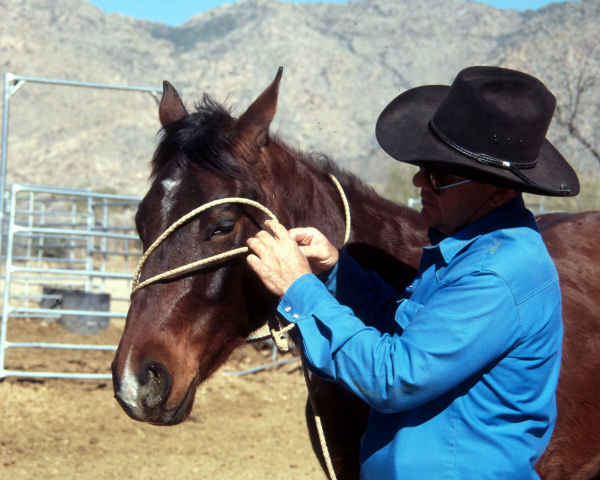
3. Take a second coil and loop it under and over the nose again, placing the second coil over the top and above the first coil on the front of the nose.
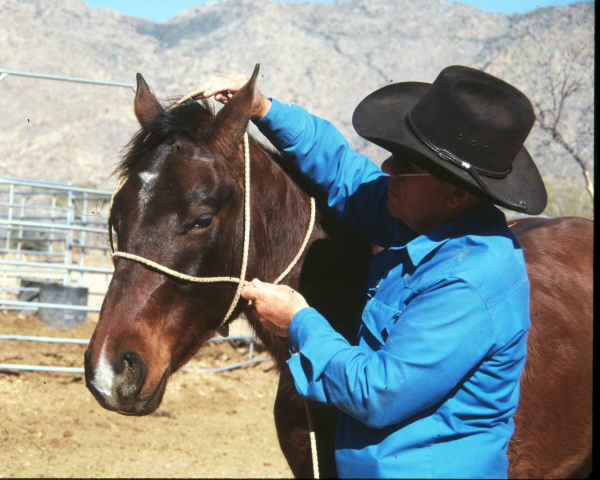
4. Render the first coil out. Pull it up over the second coil and up over the top of the head and ears until the reata coil rests around the neck directly behind the ears with the first loop. 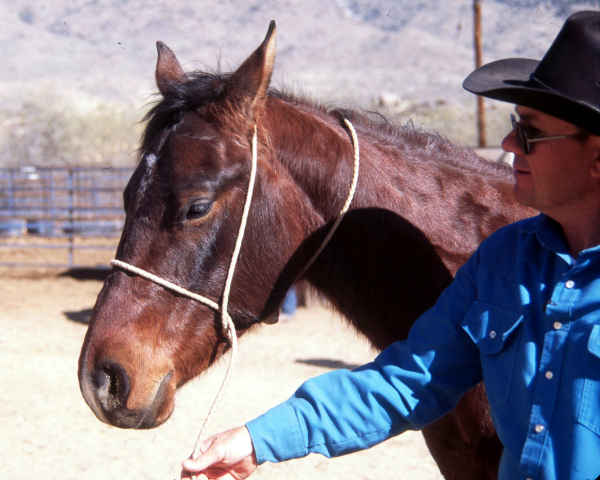
One thing to be careful about : keep the coils of the reata out of the horse's eye. Keep the nose coil down and square across the nose.
(click on photos to see enlarged views) |
|
Twister likes to put the reata on this way because if it slips off the horse's nose, you still have a loop around his neck. This way also renders a little better. There are other ways to put it on, but the rope can come off and the horse will be turned loose.
The cowboy halter works by applying pressure on the nerves of the poll, nose, the side of the face and under the jaw, as does bridle, bit, or conventional halter. Be sure you do not force the horse to follow, just outlast the horse when you put pressure on the reata. Start gently, and increase pressure just to the point where you will get a response.
Then every time that you pull, make it just tough enough so that the horse responds; yet, the horse does not fight you. If you pull on the reata and the horse tries to fight it any, just go with the horse until he responds. If he gets to going backwards, just go with him. Pretty soon the horse will take a step forward with the pressure of the reata. When he does, stop, loosen all the coils on the nose and head. Then rub where all the pressure points are --where the reata sits behind the ears, where it touches on the side of the face. It is very important that you let the horse know that when he comes forward he gets slack in the reata and relief from pressure. After the horse begins following, challenge him a little. Ask him to follow you through harder areas. The two-year-old colt in these pictures had never had the cowboy halter on before.
The cowboy halter works by applying pressure on the nerves of the poll, nose, the side of the face and under the jaw, as does bridle, bit, or conventional halter. Be sure you do not force the horse to follow, just outlast the horse when you put pressure on the reata. Start gently, and increase pressure just to the point where you will get a response.
Then every time that you pull, make it just tough enough so that the horse responds; yet, the horse does not fight you. If you pull on the reata and the horse tries to fight it any, just go with the horse until he responds. If he gets to going backwards, just go with him. Pretty soon the horse will take a step forward with the pressure of the reata. When he does, stop, loosen all the coils on the nose and head. Then rub where all the pressure points are --where the reata sits behind the ears, where it touches on the side of the face. It is very important that you let the horse know that when he comes forward he gets slack in the reata and relief from pressure. After the horse begins following, challenge him a little. Ask him to follow you through harder areas. The two-year-old colt in these pictures had never had the cowboy halter on before.
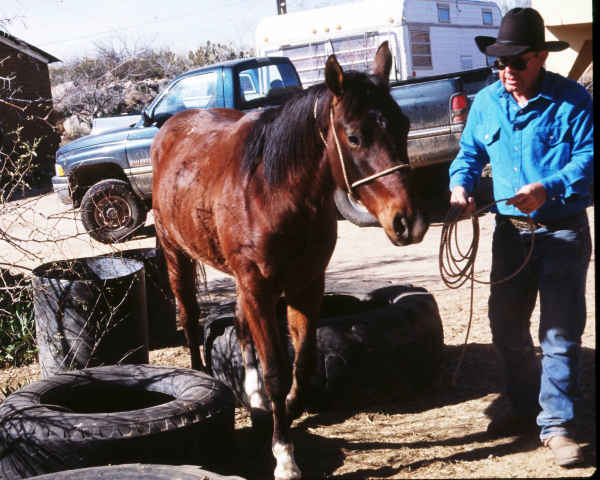
Twister really likes the cowboy training halter made from a reata because even when a person is halter breaking baby colts, you can teach the horse to go easily and willingly wherever you go. They will follow you willingly through too narrow a gate, into a barn, a trailer, or through scary or uncomfortable terrain. A colt or spoiled horse will quickly respond and lead like a well-trained, well-behaved horse, because they respect the reata. When horses become slow to lead or refuse to lead into a horse trailer, you can tune them up with the cowboy training halter.
Twister has done this with wild colts that had never been caught before. He led them with a halter & butt rope for a couple of days. On the 3rd day, he introduced them to the reata halter. On the fourth day, he led the colts through rocks & obstacles.
Often times, the first thing that happens when you start training a horse is that the horse doesn't want to be lead because the horse knows that when you catch them they have to go to work. They do not want to lead up to the saddle-up place, round corral, horse trailer, etc. This cowboy halter will make the horse respect pressure and pretty soon when you pull on the lead rope a little bit they will lead right up at a trot. When they come up correctly, respond in a positive way. Be sure you loosen the reata up and show them "Yes, that is what I want!" If the rope does not give enough, loosen it by hand. Remember that you can use any kind of a rope as long as you loosen it. Make sure it loosens up. The biggest key is to pet & rub the pressure points where the reata tightens. Soon when the horse feels the reata begin to close up he will follow without waiting for the reata to tighten. After a couple of days of this practice, if your horse is responding well, you can test him by leading him through a narrow gate opening.
Twister has done this with wild colts that had never been caught before. He led them with a halter & butt rope for a couple of days. On the 3rd day, he introduced them to the reata halter. On the fourth day, he led the colts through rocks & obstacles.
Often times, the first thing that happens when you start training a horse is that the horse doesn't want to be lead because the horse knows that when you catch them they have to go to work. They do not want to lead up to the saddle-up place, round corral, horse trailer, etc. This cowboy halter will make the horse respect pressure and pretty soon when you pull on the lead rope a little bit they will lead right up at a trot. When they come up correctly, respond in a positive way. Be sure you loosen the reata up and show them "Yes, that is what I want!" If the rope does not give enough, loosen it by hand. Remember that you can use any kind of a rope as long as you loosen it. Make sure it loosens up. The biggest key is to pet & rub the pressure points where the reata tightens. Soon when the horse feels the reata begin to close up he will follow without waiting for the reata to tighten. After a couple of days of this practice, if your horse is responding well, you can test him by leading him through a narrow gate opening.
The cowboy halter can help horses with trailer loading and learning to lead well for a pack string. Twister has trained show horses to position correctly for halter classes using the cowboy halter instead of a regular halter and whip. In addition, the cowboy halter can aid even a well-broke horse get through dangerous, but necessary places. Twister tells of a time when he had to go down a steep boulder strewn mountain side. He was in a very rough place riding after cattle. No one knew where he was. He took off his bridle, fashioned a cowboy halter out of his catch rope, and led his mount down the hillside to safety. The horse would never have led by the bridle reins. He says he would still be there without the cowboy halter.
This method of teaching to lead using the cowboy halter is not nearly so severe as tying a horse up solidly when they are green-broke. The horse will learn to lead better and to go where you want. One caution: Never tie a horse up solidly with this rig. The principle is that you are not forcing them, you are teaching them. If you tie a horse up with the cowboy halter there is no way for the horse to get relief if they want to fight the cowboy halter. Once the horse is leading with this cowboy halter, the horse will stand better tied with a regular halter and not want to fight it. They will probably not even tighten the rope by the second application. When you are leading a horse, as you speed up they will too.
Twister teaches all his horses to stand tied up. That teaches them patience. However, if you tie a young horse up solidly with any halter and he fights a lot, there is no way to get relief when he hits the end of the rope. The horse can get sore around the head or injure its neck. Twister believes tying a horse solidly is much harsher than the cowboy halter, where you can give the horse instant relief when it cooperates, outlasting the horse, rather than forcing it. Pretty soon the horse steps forward. Then you can loosen the rope and the horse learns something positive. This way, the horse learns to respect pressure from a rope or halter, and will become a better all around horse.
This method of teaching to lead using the cowboy halter is not nearly so severe as tying a horse up solidly when they are green-broke. The horse will learn to lead better and to go where you want. One caution: Never tie a horse up solidly with this rig. The principle is that you are not forcing them, you are teaching them. If you tie a horse up with the cowboy halter there is no way for the horse to get relief if they want to fight the cowboy halter. Once the horse is leading with this cowboy halter, the horse will stand better tied with a regular halter and not want to fight it. They will probably not even tighten the rope by the second application. When you are leading a horse, as you speed up they will too.
Twister teaches all his horses to stand tied up. That teaches them patience. However, if you tie a young horse up solidly with any halter and he fights a lot, there is no way to get relief when he hits the end of the rope. The horse can get sore around the head or injure its neck. Twister believes tying a horse solidly is much harsher than the cowboy halter, where you can give the horse instant relief when it cooperates, outlasting the horse, rather than forcing it. Pretty soon the horse steps forward. Then you can loosen the rope and the horse learns something positive. This way, the horse learns to respect pressure from a rope or halter, and will become a better all around horse.

