HOW TO TEACH A HORSE TO STAND STILL WHILE A RIDER MOUNTS
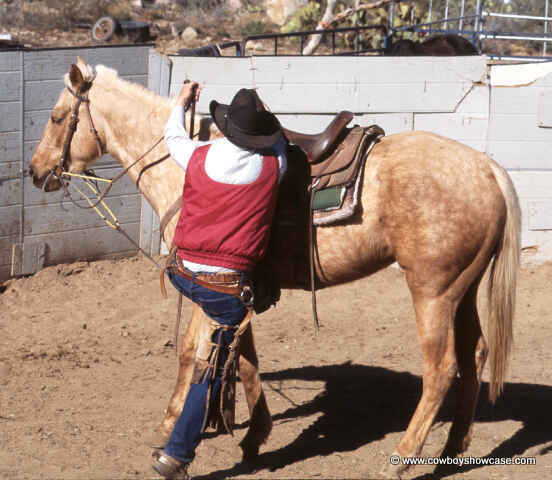
One of the most irritating problems for some riders is a horse that walks off while they are mounting. Horse traders can add a few hundred dollars to a horse's sale price by teaching it to stand still while a rider mounts. Horse trainers spend time adding this item to a well-trained horse's regimen. What can we do at home to keep a horse standing correctly when we mount?
Twister Heller, Congress, Arizona horse trainer, has a few helpful steps that he uses in his training procedure. 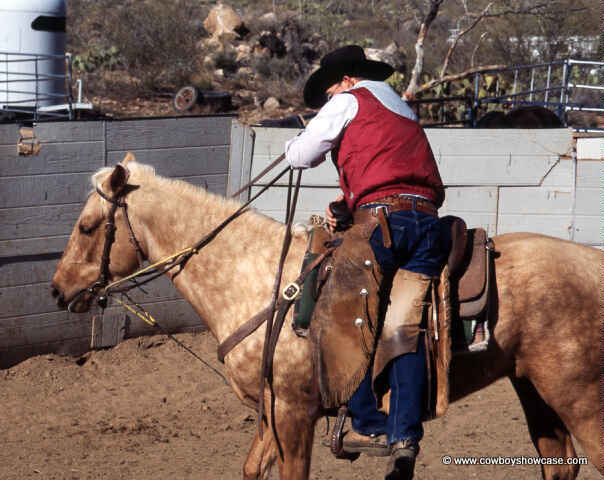
First Twister has the horse stand in a spot where the horse is comfortable and standing squarely on all four feet. Then Twister prepares to mount by having his left hand on the reins, puts his left foot in the stirrup and his right hand on the saddle horn. Note that, contrary to what some of us have been taught, Twister likes both reins short and even. The reins should not be pulling on the horse's mouth (making it back up), but still should be short enough to check any forward movement quickly and easily. Twister likes both reins even so that the horse will not be pulled in any direction.
Twister puts his weight in the stirrup, ready to check any forward movement of the horse with his left hand. Initially, for training purposes, Twister usually goes slowly, allowing the horse to think about the process and understand what he wants. When the horse is not moving, Twister finishes the mounting, by swinging his right leg over and settling into the saddle. 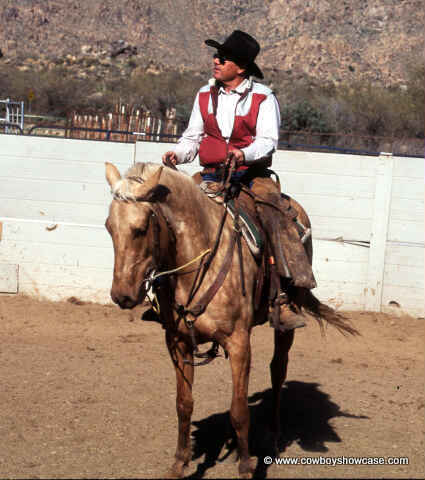
A final, but very important step---Twister then sits quietly on the horse for several seconds, not allowing it to go forward until Twister is ready. That teaches the horse not to move until the rider asks it to move.
Occasionally, a horse will decide that it will try to back up every time you try to mount. To stop that, while standing on the ground, Twister will sharply pull directly forward with the reins each time the horse goes backwards. He is sure to remove his cowboy martingale or other extra gear when he does this so he will not give the horse any confusing signals. He will repeat the tugs until the horse will allow him to approach from the side and mount without its backing up. A person without the strength or agility to mount correctly is at a disadvantage with this procedure. Those persons who cannot step directly up using one hand on the reins and one on the saddle horn should still check the horse's forward movement as often as they can while mounting. Often that can be done with one or both feet still on the ground and again when the rider has mounted. They can be extra careful to keep the horse standing several seconds before they ask the horse for forward movement after they are mounted. As with most training techniques, taking time to let the horse know what is expected and repetition are the keys. Twister Heller operates a horse and rider training facility in Congress, Arizona. He may be reached at P.O. Box 747, Congress, Arizona, 85332. His telephone number is 928-427-6335. mailto:twister@twisterheller.com
A version of this article first appeared in Western Horseman Magazine: August 1999, p. 152. |
|

