READING AND UNDERSTANDING LIVESTOCK BRANDS
Brands are one of the most interesting tools used by livestock people. Each brand is by necessity different than all the others and often conveys the character of the owner.
Our most popular feature is Livestock Brands. We would like to enhance your experience here on this subject. Please post your brand questions on our Facebook page. Check with the agency in your state concerned with the registration of brands for local regulations. It is usually the Department of Agriculture. The origin of branding livestock dates from 2700 B.C. Paintings in Egyptian tombs document branding oxen with hieroglyphics. Ancient Greeks and Romans marked livestock and slaves with a hot iron before. Hernando Cortez introduced branding from Spain to the New World in 1541. He brought cattle stamped with his mark of three crosses. There has never been anything to take the place of a visible brand as a permanent definitive mark of ownership and deterrent to theft. Livestock people say "a brand's something that won't come off in the wash."
The original Spanish brands were, as a rule, complicated, and beautifully rich in design, but not always practical. The early American ranchers wanted more simple designs that were easy to remember, easily made, that did not blotch, and that were hard to alter. 
Brands, both hot iron and freeze brands, are recorded by state livestock agencies in many states. In some states freeze brands are not valid on cattle. The agencies also record the location you place the brand on the animal. You may not register a particular brand if the same symbols and location have already been registered by someone else in your area. It is important, not only to register a brand correctly, but to keep it active. Like most registrations, brand registrations do expire. Check with the agency in your state concerned with the registration of brands for local regulations.
A number of states do not have brand inspection systems. For instance, Texans register brands in their county clerk's office and do not have a state-wide agency overseeing the 254 counties. See Texas information below. Horse brands and cattle brands are often registered separately. BLM Mustangs have multi-character freeze brands on the left side of their necks. Registered Arabian horses have the same type of brand on the right side of the neck. Thoroughbred horses have registration numbers tattooed under their upper lips. See our brands page two for examples. Branding is very important in proving ownership of lost or stolen animals. An unbranded animal is called a "slick," and is almost impossible to legally identify. No other way is as easily visible as branding, not only for identification, but as a deterrent to theft. Other methods such as implanted computer chips are positive identification, if a new owner is aware of them, but hot or freeze brands are highly visible and hard to alter. "Trust your neighbors, but brand your stock." Horse brands: In addition to a brand, a horse owner should have good identifying photographs of their animals. If a horse is lost or stolen, the owner should immediately contact local brand authorities, slaughter houses and auction yards with brand information and photographs showing distinguishing markings. The most popular locations for brands on horses are the left or right hip or the left or right shoulder. Other less common locations are ribs, stifles, and jaws. Cattle are usually branded on hips and ribs. Reading Brands For many new livestock owners, the art of reading a brand is a mystery . Brands, to the inexperienced, resemble hieroglyphics; to the experienced livestock person, however, they become a readable language. With practice and an understanding of some important brand terms, the average person can easily acquire basic skills in reading brands. Brands have a language all their own. That language, like any other, follows certain rules. The ability to read these symbols is referred to as "callin' the brand." Brands are composed of capital letters of the alphabet, numerals, pictures, and characters such as slash /, circle O, half-circle , cross +, _bar, etc., with many combinations and adaptations. Letters can be used singly, joined, or in combinations. They can be upright, XIT ; lying down or "lazy," (lazy S); connected ( V B connected) or combined, (V B combined); reversed, (reverse B); or hanging (V hanging S). Figures or numbers are used in the same way as the letters. Picture brands are usually used alone, for example (ladder) or (rising sun). There are three accepted rules for reading brands. 1. Read from the left to the right as ML (M L). 2. Read from the top to the bottom as (bar m). 3. When the brand is enclosed, it is read from the outside to the inside as(circle S). The reading of a brand, especially the more complicated ones, in one locality or state may not correspond to the way it is read elsewhere. Today, with the influx of Mexican horses from south of the border, we see a lot of odd, hard to read "scripty" brands, a little reminiscent of the old elaborate Spanish brands. Many of them look like they are applied with a "runnin' iron." Unlike a pre-shaped, stamp style branding iron, a running iron is a straight or curved piece of metal that is heated and then the brand is drawn rather than just stamped on the animal. Your brand protects your livestockThe first step in protecting your livestock is choosing a good brand.
Choose a brand that is distinctive and readily recognized. Your state's brand inspector's office will help you to select a brand that has your desired qualities within the limits imposed by current brand laws. Be sure to record your chosen brand in your state's brand inspection office. Unrecorded brands offer little or no protection and add confusion. There are a couple of things to consider when choosing your brand. Choose as simple a brand as possible. Today most new brands will need to be three characters because there are so many already registered. In fact, older single and two figured brands are often sold with ranches, or even by themselves if they are not needed by the original owners. They can command a good price. When choosing the characters, try to avoid "closed" characters since they are more prone to blotching. The smaller the closed space, the more chance of blotching. The letter C is an "open" character. So is the character "_" or bar. The letters A and B and the number 8 are examples of closed characters. The more simple the brand, the less likelihood of it's blotching and being unsightly and hard to read. When selling animals you should protect yourself and others by insisting that the buyer takes a complete, properly filled out bill of sale. Also require a bill of sale when you buy livestock. On animals with more than one brand, be prepared to offer proof of purchase. If you transfer ownership of a registered brand, the state involved will usually provide a bill of sale for that purpose if you request it. Apply the brand properly. Most states require a brand to be in a certain place on the animal's body and of sufficient size to be readily seen. It should be clearly and cleanly burned in with a hot iron or freeze branded. Cattle branding irons should have a face at least 3/8 inches wide. The letters, figures or characters should be four inches in length. Make your brand as large as necessary. It is a myth that big plain brands affect the sale price of cattle. Some of the best sized brands regularly take top price on the market and win show prizes. Some horse owners do not like the idea of a brand "marring" the looks of their animal, but when viewed properly a good legal brand is one of the best gifts you can give your horse. Many animal owners are not willing or not equipped to correctly brand an animal. Your local veterinarian or branding professional will be happy to assist you if you need help. For those of you who are comfortable with the process, the following guidelines are presented. To make a clean brand, use a hot iron. Do not allow the iron to get red-hot because that can cause a hair fire and result in a poor brand. A properly heated iron is the color of ashes. Do not use a forge or a coal fire. Wood is the best fuel for a branding fire. Use of certain acids or other similar agents that leave a scar instead of a brand often cause a bad sore and result in an unreadable brand. Too thin an iron will cut too deeply or make a thin scar that will cover over with hair and will necessitate clipping to read. Never try to brand a wet or damp animal. The brand will scald, leaving a blotch, a bad sore, or no brand at all. Don't put the iron in the hands of an amateur. In some places, only the owner or foreman would handle the iron and it was against all etiquette to brand another person's stock. Never place a new brand over an existing brand. Don't get tender hearted. The branding iron must burn deep enough to burn the hair and the outer layer of skin. When the branding iron is lifted, the brand should be the color of saddle leather. Work as slowly and carefully as necessary. The animal will bear the brand all its life and you want it to always bring the animal home. Here is a very informative paper from Texas Agricultural Extension Service on freeze branding: Freeze Brand Horses.pdf How to Find Out About Your Brand:One question that is often asked is "My animal has this brand. Where does the animal come from?" or "What is his history?" The authority on brands in your area is the local brand inspector. If you think a horse came from a different area you can contact the brand inspection board for the state that you are interested in. The brand department is usually under the jurisdiction of the state's department of agriculture.
These professionals have the records to check to find out who owns the brand in question. Also, if you find a strayed animal, the brand inspector can find the correct owner. Conversely, if you lose an animal you should contact the local brand inspector with the brand and description of the lost animal. Some states, such as Arkansas, have brand registration, but it is not mandatory and many brands are not registered. In that case, the registered brand takes precedence over a non-registered brand in case of a question in ownership. In states without brand recording laws, state livestock associations (like the state's cattlemen's association) can often be helpful. Links to find out about your brand To help in your search for information relating to state brands and brand laws, we provide the following links to state departments of agriculture and other relevant agencies. Check with the agency in your state concerned with the registration of brands for local regulations. Use these links and the following contact information to find out about your brand. General Information: State and Provincial Livestock Brand Agencies http://asci.uvm.edu:80/equine/law/index.html University of Vermont resource materials on equine law and horsemanship safety. Canada
The bar N brand on the left shoulder, -N , is the brand of the Navajo Nation in Arizona and New Mexico. That, along with the three character brand on the animal's left hip designate the grazing permittee that owns the stock. For more information contact: Navajo Nation Veterinary and Livestock Program (928) 871-6615 Navajo Nation Switchboard (928) 871-6000 California California Brand Book online. Colorado Colorado Livestock Inspection Florida Florida Livestock Brands Georgia Brand information http://agr.georgia.gov/00/article/0,2086,38902732_0_41051091,00.html Animal Industry - Animal Health Dr. Carter Black Associate State Veterinarian 19 Martin Luther King, Jr. Dr., S.W. Room 102 Atlanta, Georgia 30334 Tele: (404) 656-3667 Fax: (404) 651-9024 Dr. Maria Luke, Assistant State Veterinarian, Room 101 Idaho: http://www.isp.idaho.gov/brands/index.html P.O. Box 1117 Meridian, ID 83680-1177 700 S. Stratford Dr Meridian, ID 83642 Ph: 208.884.7070 Fax: 208.884.7097 Toll Free: 1.800.772.8442 (Idaho Only) Kansas Animal Health Department: http://agriculture.ks.gov/divisions-programs/division-of-animal-health/brands-program Kentucky online Brand Book KY Department of Agriculture, 111 Corporate Drive, Frankfort, KY 40601 Phone: (502) 564-4696 Fax: (502) 573-0046 Mississippi https://www.mdac.ms.gov/bureaus-departments/agriculture-livestock-theft-bureau/ Montana http://liv.mt.gov/BE/brandsinfo.asp For questions regarding new brands, or brand transfers please call 1-406-444-3812. For any other questions regarding the brands department please call 1-406-444-2045. ALL MAIL SHOULD ADDRESSED TO: DEPARTMENT OF LIVESTOCK BRANDS ENFORCEMENT DIVISION PO BOX 202001 HELENA, MONTANA 59620-2001 The Montana Cattlemen’s Association has recently compiled all of the registered Livestock brands listed in Montana and have made this accessible on our web site. There are approximately 54,000 brands registered in the State of Montana. This is a completely searchable data base. You may search by specie, county, brand position or by characters of the brand or by brand owner. They say, "We acknowledge the need for livestock identification and are firm believers in our brand system, and hope that this will aid the livestock industry in identifying branded animals from our state. This is has been a very large and costly undertaking and so we made this service available to our members, as we are a non-profit organization. Anyone can join and the cost is 50.00 per year. There are 3 free searches for you to try." Here is the web address www.montanacattlemen.org. Nebraska: Nebraska Brand Committee Nbc.nebraska.gov 411 Niobrara Ave Alliance NE 69301 (308) 763-2930 Nevada Department of Agriculture, Division of Livestock Identification. Address: 4780 E Idaho Street, Elko, NV 89801 Phone: 775 738-8076 Website: http://agri.state.nv.us http://agri.nv.gov/Animals/Livestock/Brand_Book/ New Mexico For Information on New Mexico Brand Laws Contact the New Mexico Livestock Board http://www.nmlbonline.com/ 300 San Mateo Blvd. NE Suite 1000 Albuquerque, NM 87108-1500 (505) 841-6161 Main Number (505) 841-6160 Fax Oklahoma: https://www.okcattlemen.org/brand-reg-renewal South Dakota http://www.sdbrandboard.com/ 413 S. Fort Street Pierre, South Dakota 57501 Phone: (605) 773-3324 Texas The state of Texas records brands by county. Texas brands are recorded with the county clerk of the county in which the animals are located. Each Texas county also sends a copy of the brand registration to the Texas and Southwestern Cattle Raisers Association, who enters the brands into a database for retrieval by their officers / inspectors, and can be used by other law Enforcement entities in their theft investigations. Texas also stations over 70 inspectors at livestock sales facilities around the state to monitor animals, as well as sellers passing through these facilities. The organization has jurisdiction in both Texas & Oklahoma for its Law Enforcement functions, and Field Inspectors are Commissioned in Texas & or Oklahoma, as Sworn Peace Officers. The association is also the go-to agency for Texas Brand Inspection documents for those animals traveling to or through mandatory inspection states. Our thanks to S. M. Clark, Brand Inspector with the TX & SW Cattle Raisers Assn Law Enforcement / Inspections Division for providing this information. Washington State Department of Agriculture Livestock Identification Program P.O. Box 42560 Olympia, WA 98504-2560 (360) 902-1855 EMAIL: livestockid@agr.wa.gov An extensive digital library of learning resources for veterinary professionals and people with an interest in animal welfare here: http://vettechnicians.org/ http://agr.wa.gov/FoodAnimal/Livestock/WhoToContact.aspx Wisconsin contact information Brand Registration DAH 608-224-4889 Wyoming Livestock Board 1934 Wyott Drive Cheyenne, WY 82002 Telephone (307) 777-7515 Fax (307) 777-6561 http://wlsb.state.wy.us/brands.htm The following helpful information was provided by
Danna Schwenk Technology Coordinator/Project Manager State of Nebraska Brand Committee Inspections: California – mandatory on cattle Colorado - Mandatory on cattle horses mules and donkeys Idaho – mandatory inspection cattle horses mules and asses, Montana – mandatory on all hooved animals Nebraska -mandatory split state at Grand Island (line north and south). Everything West of there is mandatory inspection. Inspection services provided on request in the East. Nevada mandatory for cattle horses burros mules and pigs, New Mexico – mandatory on cattle, sheep and horses North Dakota – mandatory cattle horses mules Oregon – mandatory on cattle South Dakota – mandatory inspection west of Missouri river Utah – mandatory for Cattle Horses and Sheep Washington, mandatory has E-Inspection too Wyoming – mandatory cattle, sheep horses mules or asses Kansas – Registered Brand state but not mandatory inspection. 6 northern livestock markets choose to contract for brand inspection or voluntary local inspections Texas/OK – registered brands, special investigators, sale barn inspections States with their own Brand Registrations: Alabama registered brands Arkansas registered brands Florida registered brands Georgia registered brands Kentucky registered brands Illinois registered Brand Indiana registered brands Louisiana registered brands Michigan registered brands Minnesota registered brands Missouri registered brands Mississippi registered brands New York registered brands North Carolina Registered brands Ohio registered brands South Carolina registered brands Tennessee registered Brands Virginia registered brands West Virginia registered brands Wisconsin registered brands |
|
Positive animal ID information:
We have a system in place for animal identification. Expand and empower what we have on a state level. Why do we need a new Federal standard?
Here are some sites that focus on this issue. Please e-mail with links or ideas.
Cattlemen's Associations
California Cattlemen's Association
Canadian Cattlemen's Association
Independent Cattlemen's Association of Texas
Kansas Cattlemen's Association
National Cattlemen's Beef Association
Oklahoma Cattlemen's Association
Texas and Southwestern Cattle Raisers Association
The information provided by these state and organization links is outside our site and beyond our control. Please let us know any changes that are available.
We have a system in place for animal identification. Expand and empower what we have on a state level. Why do we need a new Federal standard?
Here are some sites that focus on this issue. Please e-mail with links or ideas.
Cattlemen's Associations
California Cattlemen's Association
Canadian Cattlemen's Association
Independent Cattlemen's Association of Texas
Kansas Cattlemen's Association
National Cattlemen's Beef Association
Oklahoma Cattlemen's Association
Texas and Southwestern Cattle Raisers Association
The information provided by these state and organization links is outside our site and beyond our control. Please let us know any changes that are available.
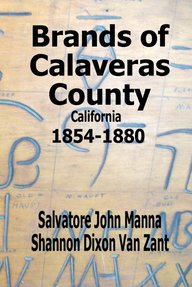
BOOK CELEBRATES CALIFORNIA RANCH LIFE BY DOCUMENTING THE LIVESTOCK BRANDS OF CALAVERAS COUNTY
BURSON, CA – February 6, 2017 – For those fascinated by the history of early California, brands of the Old West, and/or ranching in America, the newly published Brands of Calaveras County, California 1854-1880 offers a rare glimpse into the past through the brands associated with one county’s ranchers. Believed to be the only book of its kind ever published, Brands of Calaveras County, California 1854-1880 explores the earliest brands recorded in one of California’s original counties, beginning just after the Gold Rush. Yet what emerges from its 245 brand filings and 376 pages is not just a story of livestock brands but also a story of families--of heritage and emigration, births and deaths, marriages and children, success and failure.
The premiere release from Calaveras History Publishing, a division of the Society for the Preservation of West Calaveras History, Inc., a nonprofit charitable trust, Brands of Calaveras County, California 1854-1880 was authored by historian and journalist Salvatore John Manna and Calaveras County Archivist Shannon Dixon Van Zant.
A book signing will take place from noon-2 p.m. on Saturday, March 11th, at Common Grounds, 1900 Vista del Lago in Valley Springs. In addition, copies are available for purchase through westcalaverashistory.org, Amazon.com, and select retailers. For more information, please contact the SPWCH at westcalaverashistory@gmail.com.
For more information:
Sal Manna
westcalaverashistory@gmail.com
westcalaverashistory.org
(209) 772-0336
BURSON, CA – February 6, 2017 – For those fascinated by the history of early California, brands of the Old West, and/or ranching in America, the newly published Brands of Calaveras County, California 1854-1880 offers a rare glimpse into the past through the brands associated with one county’s ranchers. Believed to be the only book of its kind ever published, Brands of Calaveras County, California 1854-1880 explores the earliest brands recorded in one of California’s original counties, beginning just after the Gold Rush. Yet what emerges from its 245 brand filings and 376 pages is not just a story of livestock brands but also a story of families--of heritage and emigration, births and deaths, marriages and children, success and failure.
The premiere release from Calaveras History Publishing, a division of the Society for the Preservation of West Calaveras History, Inc., a nonprofit charitable trust, Brands of Calaveras County, California 1854-1880 was authored by historian and journalist Salvatore John Manna and Calaveras County Archivist Shannon Dixon Van Zant.
A book signing will take place from noon-2 p.m. on Saturday, March 11th, at Common Grounds, 1900 Vista del Lago in Valley Springs. In addition, copies are available for purchase through westcalaverashistory.org, Amazon.com, and select retailers. For more information, please contact the SPWCH at westcalaverashistory@gmail.com.
For more information:
Sal Manna
westcalaverashistory@gmail.com
westcalaverashistory.org
(209) 772-0336

