Spurs
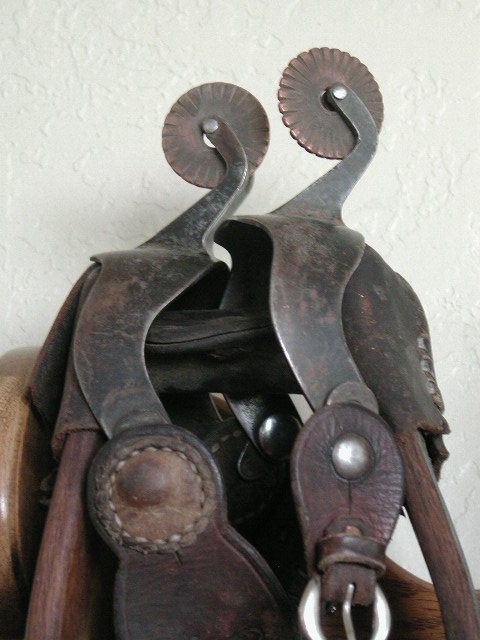
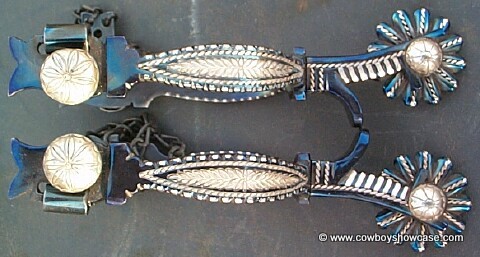
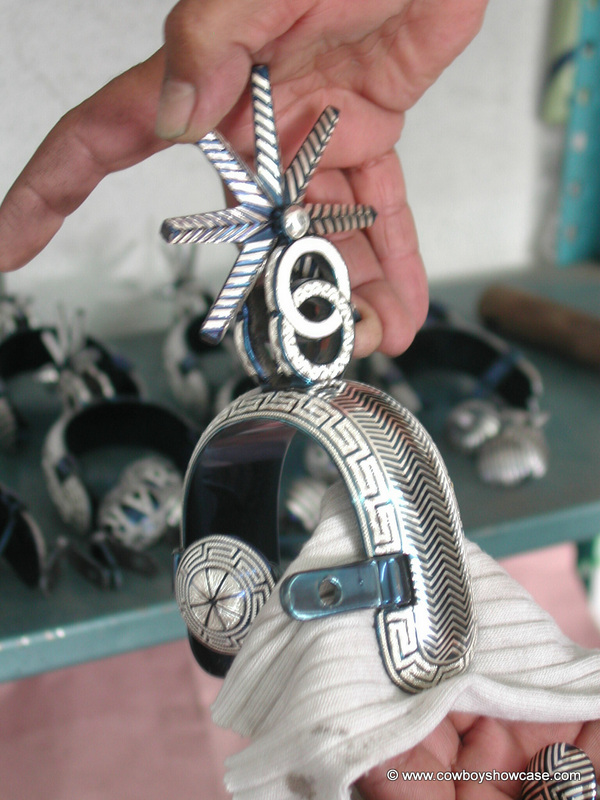
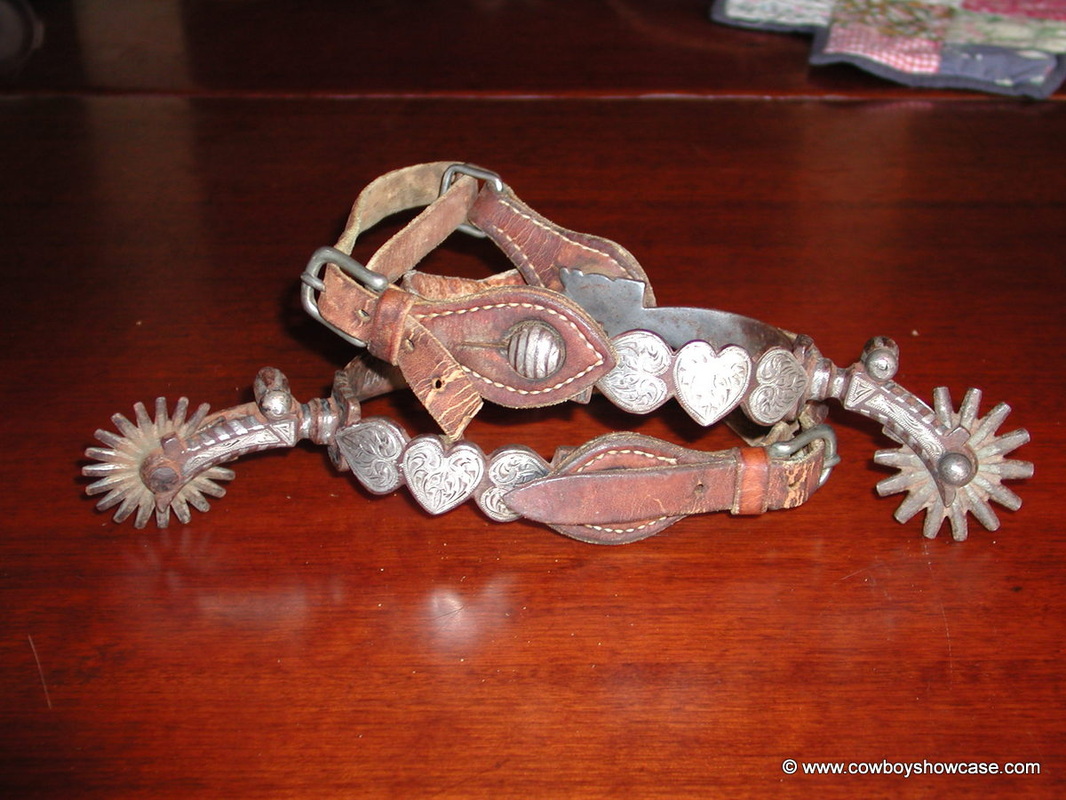
Spurs are one of the distinctive pieces of equipment that have been used by horsemen throughout the ages. In the days of chivalry, spurs and the metal from which they were made were a mark of rank. Hence the expression "to earn your spurs." Today they are a standard piece of cowboy equipment and, as with most horse equipment, the design varies widely depending upon the region and the wearer.
In today's American west, spur styles continue to change. Spurs almost invariably have rowels. The influence of ornate early Spanish design is still evident. Spur design was also influenced by the wearing of chaps. Where long chaps are worn, as in the Northwest, a dropped heel pattern and a chap guard are important. The chap guard consists of a curved blunt projection on the shank just behind the heel which helps keep the chap clear of the rowel. In areas where long chaps are not needed, a straight shank without a chap guard can be worn. History Early spurs, believed to have been used by the Roman Legions of Julius Caesar, have been unearthed in England. Early Roman, Greek, and Byzantine sculpture did not, however, show horsemen wearing spurs. The Romans developed spurs in order to have a way to steer their horses with their legs, while leaving their hands free to fight. The earliest cavalry initiated by Alexander the Great did not use spur, bit, nor stirrup. 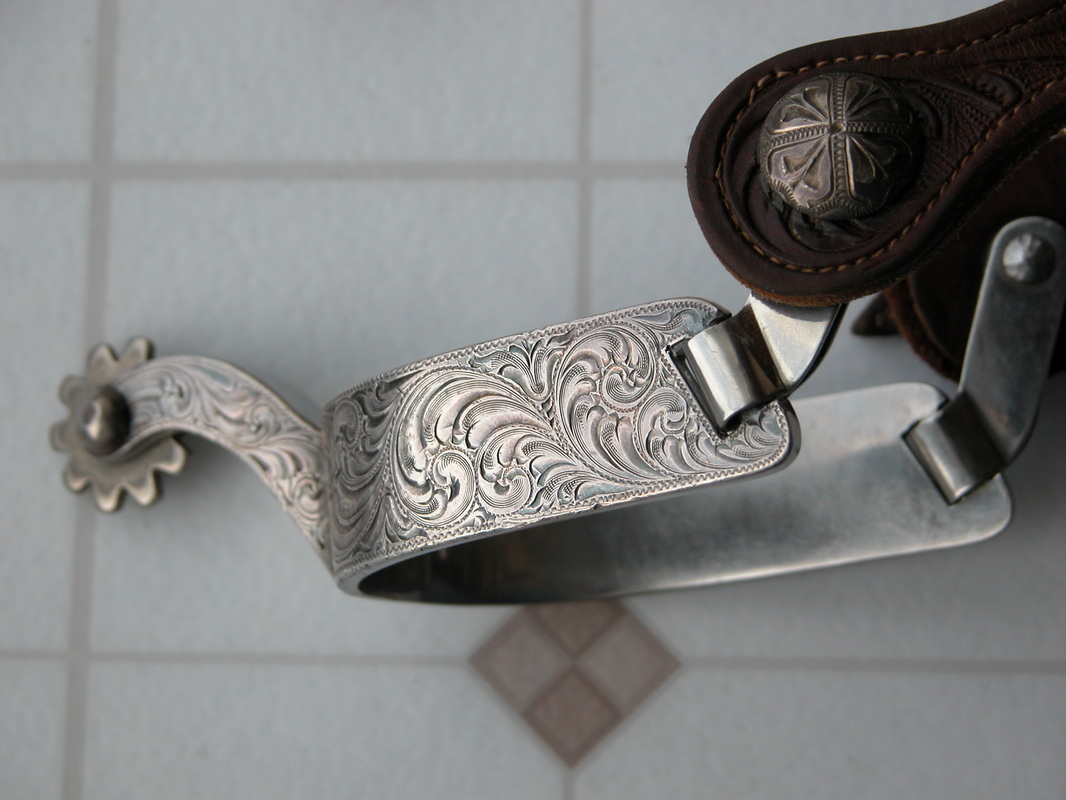
Originally, spurs had a single sharp protrusion. Etruscan tombs of the second century B.C. contained bronze spurs of this type. Many later variations of this type are found throughout Europe. The British Museum has iron examples, some with silver inlay, dating from the 11th to 13th centuries. The Mongol hordes of Genghis Khan wore similar prick spurs around the year 1200.
The revolving rowel used in modern western spurs probably originated in France. A roweled spur was shown upon the Seal of Henry III of England who lived from 1207 to 1272. This type became widely popular about the fourteenth century. During the age of chivalry, spurs became an emblem of rank. Gold or gilded spurs were only worn by knights or royalty. Esquires' were silver and those of a page were tinned. One could tell the rank of the wearer by the spurs, even if the armor or clothing gave no clue. The caste system was all-important at that time. Knights vied with each other to indicate their prestige with costly spurs. Many were jeweled and all were objects of art. Spurs were usually buried with their owner, accounting for the fact that few remain today. The Guild of Spur-Makers of Paris during the 14th century only allowed only one apprentice to each master craftsman. Apprenticeship was for six years with little or no pay. At the end of this strict training, the apprentice became a master artisan. When a valet became an esquire or an esquire was knighted, he was fitted with new spurs during a special ceremony. Thus came the expression "earned his spurs." In the rare case of disgrace, a knights spurs were chopped off in a public ceremony with the cook's cleaver. Churchmen were not permitted to wear spurs. Knights who failed to remove his spurs before entering a church had to pay a fine to the choir boys in order to regain them. In 1302 the "battle of the spurs" took place in West Flanders. 20,000 Flemish burghers on foot repulsed the attacks of 47,000 French knights on horseback. The burghers collected 700 pairs of gilded spurs as trophies of their victory. Horse armor, called "bards" influenced spur design of the time. This armor was plate lined with leather. It was introduced a piece at a time until a full set consisting of seven sections became standard by the middle of the 15th century. The section that protected the horse's flanks was called the "flanchard." In order for a spur to reach the horse an extremely long shank was developed, up to a foot in length. Bards declined in popularity and by 1600, they became rare. Accordingly, spur lengths returned to normal. In Spain, armorers developed large and ornately decorated spurs with rowels. Some of these designs came to the new world with the conquistadors. Their influence is still seen in Mexico and South America. In the United States, spur styles have also changed. In colonial days, the English style was popular. Those spurs were light and conservative with a slight curve and small rowel. Straight shanked hunting spurs were also popular. The regulation spur worn in the cavalry in 1882 was solid brass, slightly curved, with a small rowel, black straps, and brass buckle. The same type was popular during the Civil War. Later, the cavalry adopted a straight shank and eliminated the rowel. That remained standard until World War ll when army horses were replaced by other war machines. Early cavalry officer's uniform required boots and spurs. They had a duty version, a dress version that was lighter, and an extremely light dance spur for social functions. Early Native Americans apparently did not use spurs, preferring a quirt or riding whip. |
|
A number of interesting spur pages with more photos and information are listed below:
[ E F Blanchard Cowboy Spur Maker ]
[ Garcia Bits and Spurs ] [ Spurs: Prison Made Spurs ]
[ Amozoc Spurs ]
[Adolph Bayers Spurs]
[ E F Blanchard Cowboy Spur Maker ]
[ Garcia Bits and Spurs ] [ Spurs: Prison Made Spurs ]
[ Amozoc Spurs ]
[Adolph Bayers Spurs]